



Nashville sits in the Nashville Basin, a shallow bowl of thin rocky red clay over Ordovician limestone, and that geology decides how water moves under your house. In East Nashville, Sylvan Park, Belmont and Germantown, 1910s to 1940s brick and frame Craftsman bungalows, Tudor cottages and Colonial Revival homes sit on partial basements or raised pier foundations with old stone or block walls that seep every spring. Across Crieve Hall, Donelson, Inglewood and Madison, 1950s and 1960s brick ranches and split-levels have partly finished basements that take on water through floor cracks and cold joints. Out in Brentwood, Franklin, Nolensville and Mount Juliet, 1990s to 2020s brick and stone subdivision homes step down hillsides with poured-concrete walkout basements, where hillside runoff pushes hard against the downhill wall. Basement Waterproofing in Nashville means tracing the actual water path before anyone quotes a system, because a wet basement here is rarely one problem. We handle the full below-grade scope, from interior drain tile and sump systems to wall sealing, crack injection and footing drainage. Call (629) 243-3552 and we will tell you plainly what your basement needs and what it does not.
Why Basements Leak in Nashville: Red Clay, Limestone and a High Spring Water Table
The dominant failure mode in this city is hydrostatic pressure from saturated red clay sitting against the wall. That clay holds water like a sponge, and after a heavy spring downpour it pushes moisture through every pore, crack and block joint in the foundation. Add karst pockets, springs and a high water table in low spots along the Cumberland River, Mill Creek and Richland Creek, and you get basements that weep for days after the rain stops. The 2010 flood proved how fast this can escalate, and freeze-thaw nights each winter open hairline cracks a little wider every year.
- Wall seepage and efflorescence show water is moving through the masonry, not just condensing on it.
- Water on the floor after rain usually points to a failed footing drain or a clogged drain tile.
- A musty basement smell means moisture is trapped and mold growth has already started on framing or stored goods.
- Hillside runoff against downhill walkout walls is the top complaint in Brentwood, Franklin and Mount Juliet.
- Sump pump failure during a spring storm turns a manageable wet basement into a flooded one in under an hour.
Every one of those symptoms has a specific fix, and guessing wrong wastes money on the wrong system.
Key info: A 1950s brick ranch in Crieve Hall with water on the floor after every rain almost always has a collapsed clay-tile footing drain, not a wall problem. A 2015 walkout in Nolensville with a damp downhill wall usually has a surface-water problem. Same city, opposite answers.
Nashville's Metro Codes Department administers building permits for structural foundation repair and for work that alters drainage or the sanitary connection of a sump discharge, so verify requirements before work starts at the Metro Nashville Codes Department.
How We Diagnose and Fix a Wet Basement in Nashville
We start with a free basement inspection that walks the entire below-grade envelope: wall cracks, floor cracks, the cove joint where wall meets floor, window wells, the sump basin and the discharge line. We check grading and downspout extensions outside, because a downspout dumping water at the foundation corner will defeat any interior system. Then we trace the water path to its source and build the system around that, not around a template.
- We map the water path, distinguishing hydrostatic pressure from surface runoff from a failed drain tile.
- We recommend the least invasive system that solves the actual problem, and we say so when simple crack sealing is enough.
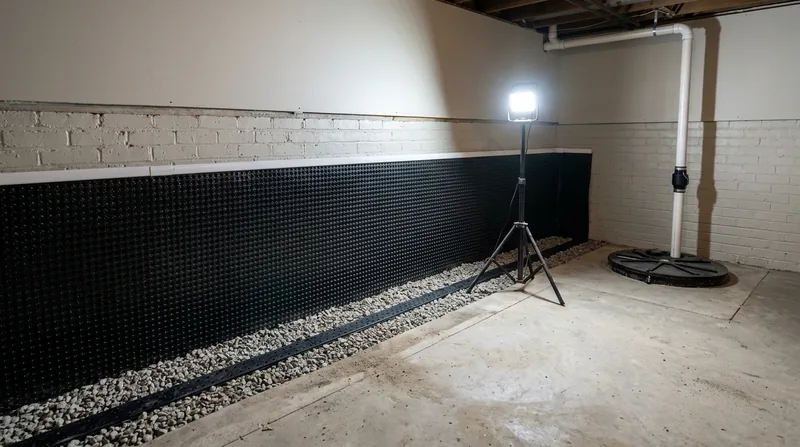
- We install interior perimeter drain tile in a gravel bed under the slab, tied to a sump basin with a check valve and a discharge line that moves water well away from the foundation.
- We treat the walls with parging, crystalline sealer or a dimple board and vapor barrier where moisture is coming through the masonry.
- We pressure-test the system with water before we backfill or close the slab, and we walk you through the discharge and backup setup.
When the problem is genuinely outside, we say so and recommend exterior excavation instead of selling an interior system that will not solve it.
Key info: On a 1962 split-level in Donelson, the basement flooded every March. The footing drain was crushed clay tile and the sump pump had no check valve, so water ran straight back in. We replaced the drain tile, set a new sump basin with a check valve and a battery backup, and the floor has stayed dry through three spring seasons.
If your home is in the 37203 corridor or the older neighborhoods around it, see our Basement Waterproofing in Nashville 37203 page for the specific building stock we run into there.
Waterproofing Methods We Use and When Each One Fits
No single method fits every Nashville basement. The table below shows how we match the approach to the failure mode, from a hairline crack in a poured wall to a full perimeter system under a finished floor.
| Approach | Description | Best for |
|---|---|---|
| Interior drain tile system | Perforated pipe in gravel under the slab along the footing, draining to a sump basin | Hydrostatic pressure, water at the cove joint, wet floors after rain |
| Exterior excavation and membrane | Footing drain replacement, dimple board and waterproof membrane on the outside face | Hillside runoff against downhill walls, failed original footing drains |
| Epoxy or polyurethane injection | Injection ports drilled along a crack, resin pushed in to seal the full depth | Individual poured-wall cracks, leaking cold joints, tie-rod holes |
| Basement wall sealing and vapor barrier | Parging, crystalline sealer, dimple board and a sealed vapor barrier | Damp block walls, efflorescence, musty basement smell |
| Sump pump with battery backup | Cast-iron primary pump, check valve, discharge line and a battery backup unit | Any basement with a drain system, especially where power flickers in storms |
We pair the method to the water path, and we tell you when a cheaper fix will hold and when it will not.
Basement Waterproofing Cost in Nashville: What to Expect
Most Nashville basement waterproofing work starts at $2,500, and that figure covers a defined scope such as crack injection, wall sealing or a partial interior drain run. A full interior perimeter drain tile system with a new sump basin, pump and discharge line typically runs well above that, and exterior excavation on a walkout is a bigger project again. The range is wide because the work is site-specific: a 1920s stone-wall basement in Germantown and a 2018 poured walkout in Franklin are not the same job.
- Linear footage of wall and floor to be drained drives the number more than anything else.
- Whether the basement is finished matters, because we protect and restore flooring and drywall.
- Access for equipment and hauling spoil out of a city lot adds labor.
- Failed or absent footing drains may require exterior excavation, which is a different budget.
- Sump pump capacity, battery backup and discharge routing are line items, not free add-ons.
Get two or three written estimates that specify the system, the materials and what happens if the problem returns, and compare scope rather than the bottom line. Our full pricing overview breaks down the ranges by system type.
Basement Waterproofing Near Me: How to Vet a Contractor Around Nashville
Waterproofing is one of the few home repairs where the wrong system can cost you twice, so the vetting matters. Ask for references from homes built in the same era as yours, because a contractor who only works on new construction may not know old stone and block walls. And confirm who pulls the permit: structural foundation repair and egress work require permits in many Middle Tennessee jurisdictions, and the rules vary by city and county, so the local building department has the final word.
- Verify the license and insurance in writing, not verbally.
- Get at least three estimates and make sure each one names the system and materials.
- Call two references from jobs at least a year old and ask whether the basement stayed dry.
- Ask whether the permit is included and who schedules the inspection.
- Check HOA rules in subdivisions like those in Mount Juliet or Nolensville before exterior work begins.
A contractor who cannot answer those questions clearly is not the one to trust with your foundation. Reach out through our contact page and we will schedule a free inspection and put the scope in writing.
Basement Waterproofing in Nashville: Pricing Guide
| Service | Price | Details |
|---|---|---|
| Crack injection (epoxy or polyurethane) | Starting at $2,500 | Includes port drilling, full-depth injection and cleanup, priced by crack length and wall thickness. |
| Basement wall sealing with vapor barrier | Starting at $3,200 | Covers parging, crystalline sealer and dimple board, with price driven by wall square footage. |
| Interior drain tile and sump system | Starting at $6,500 | Perforated drain in gravel, sump basin, cast-iron pump and discharge, priced by linear footage. |
| Exterior excavation and footing drain | On estimate | Requires an on-site look at depth, access and existing footing drain condition before quoting. |
| Travel | Included | In Nashville and surrounding areas, no separate call-out or mileage fee. |
| Estimate | Free | Response within 24h at (629) 243-3552, no obligation to book. |
Indicative pricing, the exact cost depends on square footage, finish, and site access. Free personalized estimate within 24h at (629) 243-3552.


