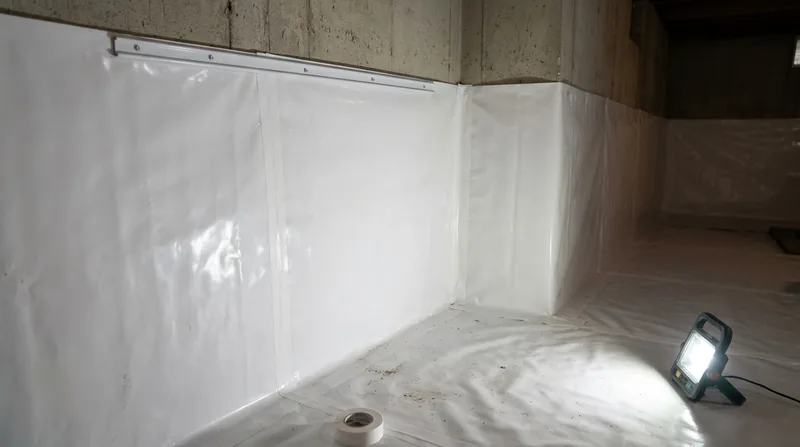




Nashville sits in the Nashville Basin on thin rocky red clay over Ordovician limestone, and that shallow, heavy soil holds water against basement walls long after the rain stops. In East Nashville, Sylvan Park and Germantown, the 1910s-1940s brick bungalows and Tudor cottages often sit on partial basements with old stone or block walls that wick ground moisture straight through the mortar. Out in Brentwood, Franklin and Mount Juliet, the 1990s-2020s walkout basements step down hillsides and pull hillside runoff against the downhill wall. Vapor Barrier Installation in Nashville is the below-grade layer that stops that ground moisture vapor from crossing into the basement air, sealing the walls and slab with heavy-duty sheet, taped seams and sump integration where the floor drains. We install it as a dedicated moisture-control measure, not a cosmetic liner, and we tell you plainly when your wet basement needs drainage first. Start with a free basement inspection so the barrier goes where the vapor is actually coming from.
Why Vapor Barrier Installation Matters in Nashville's Red Clay and Karst Terrain
Nashville's thin rocky red clay over limestone holds moisture against foundation walls and slab edges, and the high water table in low spots along the Cumberland River, Mill Creek and Richland Creek keeps that soil damp most of the year. Vapor moves through concrete and block by diffusion, not just through visible cracks, so a basement can read dry to the touch and still carry enough humidity to condense on cool walls and feed mold growth on stored materials. A properly sealed vapor barrier interrupts that path before it reaches the living space.
- The barrier blocks ground moisture vapor that passes through poured concrete and block walls even when no crack is visible.
- Sealed seams and taped terminations stop vapor from bypassing the sheet at the rim, corners and penetrations.
- Sump integration ties the barrier to the sump basin so floor moisture drains instead of pooling under the liner.
- Efflorescence and a musty basement smell are the visible signs that vapor control is missing or failing.
When the wall is actively weeping after rain, the barrier alone will not hold back hydrostatic pressure, and that is the point where an interior drain tile system has to go in first.
Key info: In Crieve Hall and Donelson, the 1950s-1960s brick ranches with partly finished basements commonly show white efflorescence on the lower block courses after a wet spring. That is vapor and capillary moisture at work, and a sealed barrier over the wall and slab is the right first step once drainage is confirmed.
For the official rules on altering drainage or sump discharge connections, check the Metro Nashville Codes Department before work begins, because thresholds vary by jurisdiction.
How We Install Vapor Barriers in Nashville Basements
We start by finding where the moisture is coming from, because a barrier laid over an active leak traps water and makes the problem worse. On a Nashville hillside walkout, that means checking the uphill wall for hydrostatic pressure and the footing drain before any sheet goes up. On a flat-lot ranch in Inglewood or Madison, it means checking the slab edge and the sump basin. The installation sequence stays the same, but the prep work changes with the house.
- We inspect the walls and slab, map efflorescence, seepage and musty odor, and confirm whether drainage is needed first.
- We clean and parge rough block or stone walls so the barrier sits flat and the adhesive and tape bond.
- We cut and fit heavy-duty vapor barrier sheet to the walls and slab, overlapping courses by the manufacturer's margin.
- We seal every seam and termination with compatible tape and mastic, and integrate the sheet into the sump basin where one is present.
- We terminate the barrier above grade level at the top and check the downspout extensions and grading outside before we call it done.
If the inspection turns up an active wall leak or a failed footing drain, we say so and point you to the right repair instead of selling a barrier that cannot do the job.
Key info: A recent Hendersonville job on a 1990s brick home had a finished basement that smelled musty every June. The slab was dry but the block wall read damp, and the barrier went on the wall with a sealed sump connection. The homeowner also extended two downspouts that were dumping against the foundation.
Where the floor needs drainage before the barrier goes down, we coordinate with our interior drain tile system work so the two systems meet cleanly at the sump.
Vapor Barrier Approaches We Use in Nashville Homes
| Approach | Description | Best for |
|---|---|---|
| Wall and slab sheet barrier | Heavy-duty vapor barrier sheet sealed across walls and floor with taped seams and terminations. | Partial and full basements with damp walls but no active seepage. |
| Wall-only barrier over parging | Barrier bonded to a parged block or stone wall where the slab is already dry. | Old stone and block walls in East Nashville and Germantown bungalows. |
| Sump-integrated barrier | Sheet sealed into the sump basin with a check valve and discharge line checked at the same visit. | Basements with a sump pump or a history of water after heavy rain. |
| Barrier with dimple board | Dimple board added behind the barrier to create a drainage gap against the wall. | Hillside walkouts in Brentwood and Franklin with runoff pressure. |
| Barrier plus wall sealing | Crack sealing and masonry sealing done before the vapor barrier goes up. | Walls with visible cracks and efflorescence that need both fixes. |
The right approach depends on the wall material, the slab condition and whether drainage is already in place, and we pick it on site rather than from a call.
Vapor Barrier Installation Cost in Nashville: What to Expect
Vapor barrier installation in Nashville starts from $3 per square foot, and that figure covers the sheet, seam tape, mastic and standard prep on a basement that is dry enough for a barrier to work. The number moves with the square footage of wall and floor, the condition of the block or stone, whether the wall needs parging first, and whether the sump has to be tied in. A simple wall-only barrier on a 1960s ranch in Crieve Hall lands near the low end; a full wall and slab job on a walkout in Franklin with parging and dimple board lands well above it.
- Square footage of wall and slab is the biggest driver, so a full basement costs more than a partial one.
- Wall condition matters, because rough stone and spalling block need parging before the sheet will bond.
- Sump integration adds a step and requires the basin and discharge line to be in working order.
- Access affects labor, and a basement packed with stored items takes longer to prep and clear.
Get two or three written estimates on the same scope so you compare like for like, and ask each contractor whether drainage is included or assumed. Our full pricing overview breaks the line items down further.
Hiring a Vapor Barrier Contractor Near Me in Nashville: What to Check
Vapor barrier work is easy to do badly, and a barrier that is not sealed at the seams and terminations will let vapor bypass it and leave you with the same musty basement next spring. Ask for proof of licensing and insurance before anyone starts, and get the certificate sent to you rather than a verbal promise. Check references on jobs similar to yours, especially older stone-wall basements or hillside walkouts where the prep work is harder. Confirm who pulls any permit the local building department requires for drainage or sump discharge changes, and check HOA rules if your subdivision in Nolensville or Mount Juliet restricts exterior work or discharge routing. Our contact page is the place to start the estimate request.
Key info: A written scope should name the barrier product, the seam and termination method, whether parging is included, and how the sump is integrated. If an estimate lists only a square-foot price with no method, ask for the detail in writing before you sign.
Call (629) 243-3552 to schedule, and we will tell you straight whether a barrier is the right fix or whether the wall needs drainage first.
Vapor Barrier Installation in Nashville: Pricing Guide
| Service | Price | Details |
|---|---|---|
| Wall-only vapor barrier | Starting at $3/sq ft | Heavy-duty sheet, taped seams and terminations on dry block or poured walls. |
| Wall and slab barrier | Starting at $3/sq ft | Full wall and floor coverage with sealed overlaps and sealed perimeter terminations. |
| Barrier with parging prep | On estimate | Rough stone or spalling block needs parging before the sheet will bond flat. |
| Sump-integrated barrier | On estimate | Sheet sealed into the sump basin with check valve and discharge line verified. |
| Travel | Included | In Nashville and surrounding areas, no separate call-out or mileage fee. |
| Estimate | Free | Response within 24h at (629) 243-3552, no obligation to book. |
Indicative pricing, the exact cost depends on square footage, finish, and site access. Free personalized estimate within 24h at (629) 243-3552.


