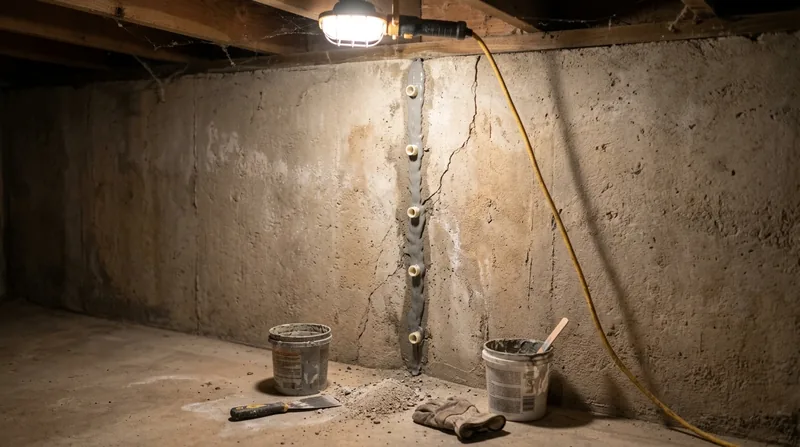




When you find a crack running across a poured-concrete wall in a 1950s Crieve Hall ranch or a hairline seam in the block of an East Nashville bungalow, Foundation Crack Repair in Nashville starts with one question: is this a shrinkage crack or a symptom of something moving? This city sits in the Nashville Basin on thin rocky red clay over Ordovician limestone, with karst pockets, springs, and a water table that climbs fast along the Cumberland River, Mill Creek, and Richland Creek. That clay swells in a wet March and shrinks in a dry August, and the freeze-thaw nights we get each winter work the same seams year after year. We inspect the crack, check for efflorescence and wall movement, and match the repair to the cause instead of smearing a patch over it. If you also see water tracking along the wall base, the crack may be one part of a larger basement waterproofing picture.
Why Nashville Soil and Old Foundations Keep Cracking
The building stock here sets the pattern. Craftsman bungalows in Sylvan Park, Belmont, and Germantown sit on partial basements and raised pier foundations with old stone or block walls that were never designed for today's runoff. Brick ranches and split-levels across Donelson, Inglewood, and Madison carry partly finished basements with poured walls that have been drying and re-wetting for sixty years. Newer walkouts in Brentwood, Franklin, and Mount Juliet step down hillsides, so the downhill wall takes constant hydrostatic pressure while the uphill side drains differently.
- Clay soil expands against the wall in spring and pulls away in summer, opening and closing the same vertical crack.
- Hillside runoff in Nolensville and Mount Juliet pushes water against downhill walls until it finds a seam.
- Older stone and block walls in Germantown develop step cracks where mortar joints give before the units do.
- Karst pockets and springs in low spots near Mill Creek let water rise against footings that were never drained.
The crack is almost always a channel for water, and the repair only holds when the water pressure behind it is addressed too.
Key info: A 1950s brick ranch in Crieve Hall with a vertical crack at mid-wall and white efflorescence below it usually points to a long-standing seep path, not a new structural failure. A step crack widening at the corner of a 1920s Germantown block wall is a different conversation and gets a different repair.
Structural foundation repair and any work that alters drainage or the sanitary connection of a sump discharge commonly require a permit, and thresholds vary by jurisdiction. Verify the current rules with the Metro Nashville Codes Department before work begins.
How We Diagnose and Repair a Foundation Crack in Nashville
We do not inject every crack we see. The inspection comes first: we map the crack's width, direction, and length, check for offset between the two sides, look for bowing along the wall, and test whether moisture is active or old. That tells us whether epoxy injection, polyurethane injection, or a structural repair is the honest answer. If the wall is moving, sealing the crack alone will not hold, and we say so.
- We walk the basement and the exterior grade, noting downspout discharge, soil slope, and any sign of hydrostatic pressure at the wall base.
- We measure the crack and check for offset, tapering, and companion cracks that suggest settlement rather than shrinkage.
- For a stable non-structural crack, we drill injection ports along the seam and inject epoxy or polyurethane under pressure to fill the full depth.
- For a wider or shifting crack, we recommend structural repair and explain the options before any injection work.
- We finish by correcting the water source, which may mean grading, a downspout extension, or an interior drain tile system if pressure is the real driver.
Every repair ends with a clear explanation of what was sealed and what still needs watching.
Key info: On a 1990s walkout in Franklin, the downhill poured wall showed three vertical cracks and damp drywall at the base. Injection sealed the cracks, but the water kept coming until we addressed the hillside runoff with exterior grading and a footing drain. The crack was the symptom, not the cause.
Crack Repair Methods We Use and When Each One Fits
Matching the method to the crack is the whole job. The table below shows how we decide, and it is the same logic we apply whether the wall is old stone in Inglewood or poured concrete in Smyrna.
| Approach | Description | Best for |
|---|---|---|
| Epoxy injection | Ports drilled along the crack, epoxy injected under pressure to bond the two sides back into one structural mass. | Stable, non-structural vertical cracks in poured concrete, typically hairline to about 1/8 inch. |
| Polyurethane injection | Flexible foam injected under pressure that fills the crack and stays flexible as the wall moves with the clay. | Active leaks and cracks that open and close with seasonal soil movement. |
| Structural repair | Carbon fiber straps or wall anchors to stabilize a wall that is bowing or shifting before the crack is sealed. | Wider cracks with offset, step cracks in block, or walls showing inward movement. |
| Drainage correction | Grading, downspout extensions, and footing drain work to relieve hydrostatic pressure at the wall base. | Cracks that keep returning because water pressure was never removed. |
In most Nashville homes, the right answer combines two of these, and we tell you which ones before you commit to anything.
Foundation Crack Repair Cost in Nashville: What to Expect
Foundation crack repair pricing starts at $450 for a single stable crack that takes epoxy injection, and that figure is realistic for a straightforward job on an accessible poured wall. The number climbs when the crack is wider, when there are several of them, when the wall is old stone or block that needs more prep, or when the repair has to be paired with drainage work to stop the water that caused it. Access matters too: a finished basement wall means moving stored items and protecting the floor before we drill.
We quote after the inspection, not over the phone, because a crack that looks simple from the outside can turn out to be a symptom of wall movement. Get two or three estimates and compare what each one includes, not just the bottom line. Our full breakdown lives on the pricing page, and the estimate itself is free.
Foundation Crack Repair Near Me: How to Choose a Contractor Around Nashville
Hiring for this work is mostly about asking the right questions. A contractor who quotes a price before inspecting the wall is guessing, and a contractor who promises a crack will never leak again without addressing the water source is overselling. Ask for proof of license and insurance, ask how they decide between epoxy and polyurethane, and ask what happens if the wall turns out to be moving.
- Confirm the company is licensed and insured and ask for a certificate before work starts.
- Get two or three written estimates that describe the method, not just a number.
- Ask for local references on homes of similar age and foundation type to yours.
- Check whether a permit is required for structural repair in your jurisdiction with the local building department.
- Ask how they will handle water pressure behind the wall if that is part of the problem.
If you want to talk through what you are seeing, contact us and we will set up a free inspection at (629) 243-3552.
Foundation Crack Repair in Nashville: Pricing Guide
| Service | Price | Details |
|---|---|---|
| Single crack, epoxy injection | Starting at $450 | One stable vertical crack in an accessible poured wall, injected and sealed full depth. |
| Polyurethane injection | Starting at $550 | Active leak or a crack that opens and closes with clay movement, flexible foam fill. |
| Multiple cracks | Starting at $850 | Several cracks on one wall, priced per crack with a lower rate as the count rises. |
| Structural repair | On estimate | Carbon fiber straps or wall anchors for a bowing or shifting wall, needs an on-site look. |
| Travel | Included | In Nashville and surrounding areas, no separate call-out or mileage fee. |
| Estimate | Free | Response within 24h at (629) 243-3552, no obligation to book. |
Indicative pricing, the exact cost depends on square footage, finish, and site access. Free personalized estimate within 24h at (629) 243-3552.


