



Bowing Wall Repair in Nashville
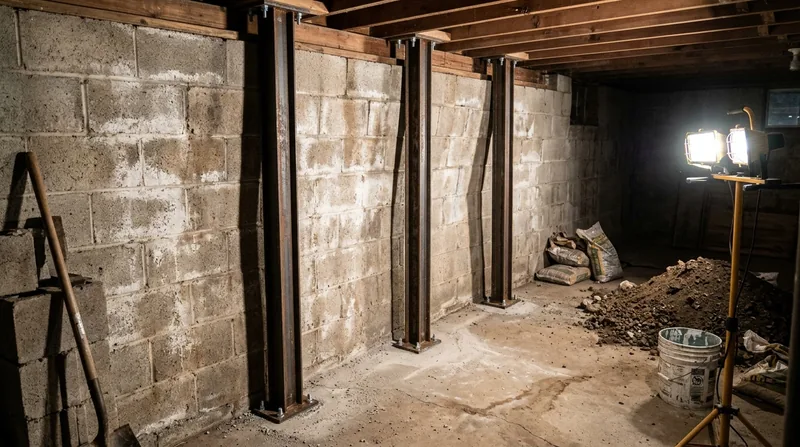
If you own a home in Nashville, you already know the ground here can be unforgiving. The city sits in the Nashville Basin, where thin rocky red clay covers Ordovician limestone, and that clay swells when it soaks up spring rain and pushes hard against anything below grade. In older neighborhoods like East Nashville, Sylvan Park, and Germantown, many homes sit on partial basements or raised pier foundations with stone or block walls that were never engineered for that kind of pressure. When a wall starts to lean or bulge inward, the cause is almost always hydrostatic pressure from saturated soil, not a cosmetic flaw, and it will not correct itself. Bowing Wall Repair in Nashville means stopping that movement with carbon fiber straps, steel I-beams, or wall anchors matched to the severity of the bow and the soil behind the wall. We specialize in below-grade work only, so we read the wall, the water table, and the drainage together before we recommend anything. If you are already seeing water at the wall base, start with our basement waterproofing service so the structural repair and the water source are handled as one problem.
Why Bowing Walls Are a Nashville Problem, Not a Cosmetic One
Nashville's heavy spring downpours, flash flooding like the 2010 event, and a high water table in low spots along the Cumberland River, Mill Creek, and Richland Creek all drive water into the clay. That clay expands, and the pressure has to go somewhere. On older block walls in Crieve Hall, Donelson, Inglewood, and Madison, the result is a wall that bows inward, cracks at the mortar joints, and sheds efflorescence as moisture pushes through the block.
- Horizontal cracking in the middle third of a block wall usually signals active soil pressure, not settling.
- A wall that leans more than an inch over eight feet needs bracing, not just patching.
- White powder (efflorescence) on the block means water is moving through the wall right now.
- Sticking doors or a floor that feels uneven near the wall can point to movement at the footing.
- Hillside homes in Brentwood, Franklin, and Mount Juliet see runoff push against the downhill wall after every big storm.
Ignoring a bowing wall lets the movement accelerate, and the repair cost climbs with it. Structural foundation repair permits are commonly required in this area, and the local building department has the final say on what your project needs, so verify the rules for your address before work starts. The Metro Nashville Codes Department is the right place to confirm permit requirements.
Key info: A 1950s brick ranch in Donelson with a partly finished basement had a rear block wall bowed about 1.5 inches. The culprit was a downspout that dumped roof water right at the corner for years, saturating the clay. We braced the wall and corrected the discharge, and the wall has held stable since.
How We Repair a Bowing Wall in Nashville
Every wall gets assessed before we quote a method. We measure the bow, check for horizontal cracking and footing movement, and look at the drainage on the wet side. The right fix depends on whether the wall is still moving and how much load it is carrying. Here is the sequence we follow on a typical Nashville job.
- We inspect the wall, the footing, and the exterior grade to confirm the direction and cause of movement.
- We map the bow with a string line and record crack widths so we have a baseline to measure against.
- We correct the water source first, because bracing a wall while clay stays saturated just delays the problem.
- We install carbon fiber straps for moderate bows, or steel I-beams and wall anchors when the wall is leaning or the soil load is high.
- We seal active cracks with epoxy or polyurethane injection so the wall is watertight at the repair.
- We re-check the wall after installation and give you a transferable warranty on the work.
The method matters less than matching it to your wall, and we tell you plainly when a simpler repair is enough. If the bow is minor and the water is the real issue, our foundation crack repair service may be the honest answer instead of a full bracing job.
Local example: A split-level in Inglewood had a front wall bowing toward the street after years of hillside runoff. We installed carbon fiber straps on 4-foot centers and added a discharge line to move roof water away from the foundation. No excavation was needed, and the wall stopped moving.
Bowing Wall Repair Methods We Use in Nashville
| Approach | Description | Best for |
|---|---|---|
| Carbon fiber straps | Straps bonded to the wall and anchored top and bottom to resist inward bow. | Moderate bowing block walls with stable footings. |
| Steel I-beams | Vertical steel beams set against the wall and tied into the floor and joists. | Heavier loads and walls that have leaned significantly. |
| Wall anchors | Anchor plates in the yard pull the wall back through rods to a interior plate. | Walls that need to be straightened, not just held in place. |
| Crack injection | Epoxy or polyurethane injected through ports to seal and bond the crack. | Active cracks in poured concrete walls after bracing. |
| Drainage correction | Downspout extensions, grading, and footing drain work to relieve soil pressure. | Any wall where saturated clay is the root cause. |
We pick the lightest method that will actually hold your wall, because overbuilding costs you money and underbuilding costs you the wall.
Bowing Wall Repair Cost in Nashville: What to Expect
Pricing for bowing wall repair depends on how far the wall has moved, how long the affected section runs, and what method it needs. A small crack injection or minor strap job can start around $600, while a wall that needs steel I-beams or anchors across a full basement wall runs considerably higher. Access matters too: a basement wall behind finished drywall or a tight lot in Belmont adds labor. The soil is the other big variable, because hillside clay in Brentwood and Franklin often needs more bracing than a flat lot in Smyrna.
Get two or three written estimates and compare the method, not just the number. A low bid that only seals the crack without addressing the pressure will not stop the bow. Our full pricing overview explains how we build an estimate and what each line covers.
Bowing Wall Repair Near Me: How to Hire the Right Nashville Contractor
When you search for bowing wall repair near me, you will find general foundation firms, plumbers, and waterproofing specialists. This is below-grade structural work, so ask questions before you sign. Confirm the contractor is licensed and insured, ask for the certificate of insurance, and get at least three estimates in writing. Ask for references from jobs in your part of town, and ask whether the repair includes fixing the water source or only bracing the wall.
Permits are commonly required for structural foundation repair, and requirements vary by jurisdiction, so confirm with the local building department. If your home is in a historic overlay or an HOA, check those rules before work begins. We are happy to walk you through the process; contact us to schedule a free inspection and get a clear, no-pressure assessment of your wall.
Bowing Wall Repair in Nashville: Pricing Guide
| Service | Price | Details |
|---|---|---|
| Crack injection or minor strap repair | Starting at $600 | Covers small crack injection or a limited strap repair on a stable wall section. |
| Carbon fiber strap system | Starting at $1,800 | Includes straps on standard spacing and anchoring; wall length and bow severity move the price. |
| Steel I-beam bracing | On estimate | Priced after on-site measurement of wall length, load, and access to the basement face. |
| Wall anchor system | On estimate | Requires exterior excavation and anchor plates; soil conditions and yard access drive the cost. |
| Travel | Included | In Nashville and surrounding areas, no separate call-out or mileage fee. |
| Estimate | Free | Response within 24h at (629) 243-3552, no obligation to book. |
Indicative pricing, the exact cost depends on square footage, finish, and site access. Free personalized estimate within 24h at (629) 243-3552.


