The Ground Beneath Your Home: Limestone, Clay, and Karst
If you live in Nashville, you are standing on some of the most geologically active ground in the country. Middle Tennessee sits on a thick layer of limestone, a soft, porous rock that dissolves slowly over time when exposed to water. That dissolving process creates voids, channels, and caves underground, a landscape known as karst. When those voids collapse or fill with sediment, the result is a sinkhole. Even without a visible sinkhole, karst terrain means water does not always travel where you expect it to. It can move sideways through underground channels and reappear at your foundation wall.
On top of the limestone sits a layer of red clay, the weathered residue of that same rock. Red clay is dense and sticky when wet, and it expands significantly as it absorbs water. When it dries, it shrinks and cracks. This cycle of swelling and shrinking, repeated season after season, puts enormous pressure on foundation walls and footings. The clay also acts as a barrier, trapping water against your foundation instead of letting it drain away. Together, limestone and clay create a one-two punch: water gets trapped near your home, and the soil itself moves enough to crack the concrete it surrounds.
Why Nashville Limestone Soil Makes Basement Leaks So Common
Nashville limestone soil is not just a geological curiosity. It is the reason so many basements in the area leak after heavy rain. The limestone bedrock underneath the clay does not drain uniformly. Water percolates down through the clay, hits the limestone, and then follows the path of least resistance. Sometimes that path leads it directly to the gravel backfill around your foundation, where hydrostatic pressure pushes it through any crack or porous spot in the concrete. This is why a basement can stay dry for years and then suddenly leak after a single intense storm. The water was always there, but the pathway finally opened up.
Homeowners in Brentwood and Franklin see the same pattern on hillside lots, where the slope concentrates water against the uphill foundation wall. That concentration is why Basement Waterproofing in this region has to account for both surface water and groundwater. A simple patch on the inside of a crack will not solve the problem if the soil outside is still saturated and pushing. The fix has to address the water before it reaches the wall.
Red Clay Foundation Cracks and Soil Movement: What to Watch For
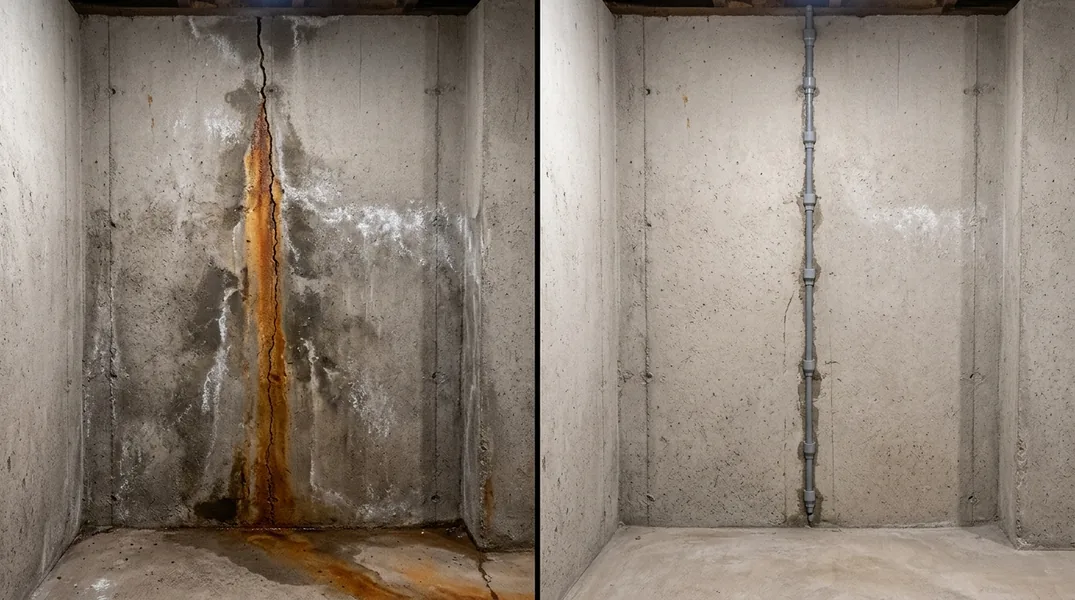
Red clay foundation cracks are one of the most reliable warning signs of soil movement in Middle Tennessee. You may notice stair-step cracks in brick veneer, horizontal cracks in a block foundation wall, or diagonal cracks that widen at the top or bottom. Inside, sticking doors and windows, uneven floors, and gaps around exterior trim all point to the same cause: the clay under one part of the house is swelling or shrinking differently than the clay under another part. This differential movement is what cracks foundations and opens the seams that let water in.
Soil movement does not always announce itself dramatically. Sometimes the first clue is a musty smell in the basement or a white powdery stain on the concrete wall, which is efflorescence left behind by water evaporating through the masonry. If you see any of these signs, it is worth getting a professional assessment before the next rainy season. Small cracks tend to grow, and the clay cycle that causes them does not stop on its own. Catching the problem early usually means a simpler, less expensive repair than waiting until water is actively pooling on the floor.
Karst Sinkholes and Foundation Risk in Middle Tennessee
Karst sinkholes foundation damage is a real concern in this part of the state, though not every sinkhole is a dramatic collapse. Many are slow subsidence features, where the ground settles gradually and takes a section of foundation with it. A home built near a karst feature may show uneven settling, cracks that keep reopening after repair, or a depression in the yard that holds water after rain. Because the limestone below is irregular, the support under your footing can vary from solid rock to loose sediment over a short distance.
This is why a proper inspection in Murfreesboro and across the region looks at more than the basement wall. It considers drainage patterns, soil conditions, and how water moves across the site. If a sinkhole or subsidence feature is affecting your foundation, waterproofing alone will not fix it, but managing water is still a critical part of protecting the structure. The goal is to keep water from accelerating the natural dissolution and erosion that karst terrain already experiences.
Basement Waterproofing Near Me: Solutions That Fit Middle Tennessee Soil
Because the soil here is so specific, the waterproofing approach has to match it. In many Nashville homes, an Interior Drain Tile System is the most practical solution. It captures water that has already made its way through the wall or under the floor and routes it to a sump pump before it can flood the basement. Interior systems are less disruptive to landscaping and can be installed year-round, which matters in a region with frequent rain.
For homes where the problem is clearly outside, Exterior Basement Waterproofing addresses the source by waterproofing the outside of the wall and improving drainage away from the foundation. This approach is often the better long-term fix when hydrostatic pressure from saturated clay is the main culprit. Many homes benefit from a combination of both, along with Foundation Waterproofing to seal cracks and protect the footing. A qualified contractor will evaluate your soil, your slope, and your water patterns before recommending a system, rather than applying the same solution to every house.
When to Call a Pro and What to Expect
If you have noticed water in the basement, cracks that seem to be growing, or a musty odor that will not go away, it is time to talk to a professional. Nashville Waterproofing serves homeowners across the area and can assess whether your issue is surface water, groundwater, soil movement, or a combination. You can call (629) 243-3552 to discuss what you are seeing, or request a free estimate to get a clear picture of the cause and the options. Understanding the geology under your home is the first step toward a fix that actually lasts.
It also helps to know what you might spend before you commit. Every home is different, but you can review general pricing guidance to set expectations. The most important thing is to address the water before it does more damage to your foundation. Middle Tennessee soil is always going to move and channel water, but with the right system in place, your basement does not have to be part of that cycle.
Looking for a professional basement waterproofing contractor in Nashville? Nashville Waterproofing responds fast for all your basement waterproofing needs.
Get a Free QuoteOur services: Basement Waterproofing · Interior Drain Tile System · Exterior Basement Waterproofing